Search
  • Temperature controller with built-in timer for powder coating Oven Feb 10 , 2023
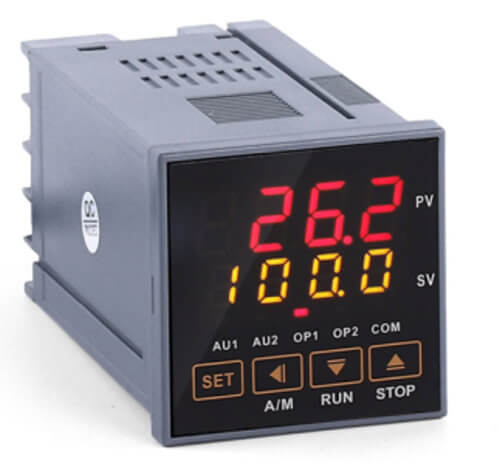
    The powder coating oven requires precise control on both temperature and time, the typical process would be hold the temperature and a set value for a certain period of time, the conventional solution would be using two control device , one is a temperature controller and the other one is a timer. At Maxwell, we have a temperature controller with built-in timer, the temperature can be controlled at a preset value and the timer can be programmed to engaged when temperature reach to set value and holding the temperature at certain period of time, when the time elapsed, the burner will be turned off. our model FT20X is a perfect solution for the oven. when the coating process finished, operator can hear a buzzer goes off to sort of notify the process is finished.
  • A Deep Dive into Kiln Controllers Dec 26 , 2023
    A Deep Dive into Kiln Controllers Introduction We are a PID temperature controller supplier in China, one of our kiln controller rolled out early of 2023 is very popular on the market and we are the first factory to introduce this kind of controller in China. Today we are going to dig deep into kiln controllers and beyond In the world of ceramics, pottery, and even certain industrial processes, the kiln plays a pivotal role in transforming raw materials into beautifully crafted and durable products. The key to achieving consistent and precise results lies in the heart of the kiln – its controller. In this blog, we'll explore the significance of kiln controllers, their functionalities, and how they contribute to achieving the perfect firing process. Understanding Kiln Controllers   A kiln controller is essentially the brain of the kiln. It is a sophisticated device designed to regulate the temperature, humidity, and other crucial factors during the firing process. Whether you...
  • What is a ramp and soak PID controller and what features should a good ramp and soak controller have?
    What is a ramp and soak PID controller and what features should a good ramp and soak controller have? Mar 05 , 2025
    ARAMP and Soak PID Controller is a specialized feedback control system designed to manage processes that require gradual changes (ramps) in a setpoint followed by stabilization periods (soaking). Unlike standard PID controllers that maintain a fixed setpoint, this controller dynamically adjusts the setpoint according to a predefined profile, ensuring smooth transitions between phases. Common in industries such as thermal processing, chemical manufacturing, and ceramics, it prevents system stress and improves process stability. Our MPU90 Series ramp and soak controller is a perfect choice. It has 0–25% FS accuracy and comes with PC software that records process values, setup values, and alarm events.   Key Features of a Good Ramp and Soak PID Controller: Accurate Setpoint Tracking: Accurately follows programmed ramp rates and soak durations, minimizing deviations even during dynamic changes. Smooth Transitions:Seamless changes between ramp and soak phases without abrupt outpu...
  • How to choose proper SCR power regulator according to your application ?
    How to choose proper SCR power regulator according to your application ? Jul 02 , 2025
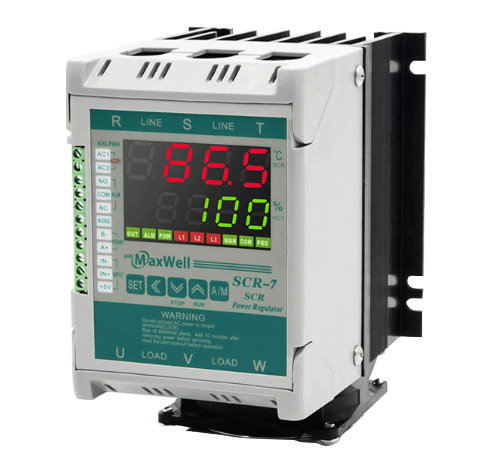
    How to choose proper SCR power regulator according to your application ? SCR power regulator is heavily used in industrial application particularly heating application, to choose proper SCR, several key factors needs to be take into consideration.  1)first thing first, figure out your source whether it is single phase or three phase, the single phase SCR is for single phase source, 3 phase SCR is for 3 phase source, like 3 phase 4 wires, 3 phase 3 wires etc. if the load is single phase, the process is quite simple, make sure you select a SCR with the current rating 2 times higher of the actual load. for example, if you have a heater with 20 amps and 240Vac load, the proper SCR would be 40 amps and 240~480Vac load2)PIDMaxwell SCR power regulator only works for resistive load, make sure your load is resistive load like a heater, electric heater, infrared heater etc3)Identify your source, the source would be 3 phase 380V 4 wires source, like in China, or 3 phase 4 wire 400V in german...
  • Why can't we just look at the kilowatt rating when selecting a three-phase power regulator?
    Why can't we just look at the kilowatt rating when selecting a three-phase power regulator? Jun 18 , 2026
    When selecting a three-phase power regulator, many customers focus first on total power—asking, "What size do I need?" based on the equipment's actual load wattage. While this approach isn't wrong, power rating alone isn't enough; we also need to consider voltage, current per phase, load type, the temperature controller's output signal, and the electrical cabinet's heat dissipation conditions. First, distinguish between single-phase and three-phase systems. Use a single-phase power regulator for 220V single-phase heating elements, but for 380V three-phase heating equipment—such as ovens, electric furnaces, heat treatment furnaces, or drying equipment—we must use a three-phase power regulator. Even if the total power is low, if the load is wired in a three-phase configuration, we cannot simply choose a single-phase unit for convenience; you must calculate the current based on three-phase requirements. The key factor is the current per phase. For instance, with a 380V, ...
  • How can the problem of circuit breakers tripping during the startup of electric furnaces or ovens using silicon carbide or molybdenum disilicide heating elements be resolved?
    How can the problem of circuit breakers tripping during the startup of electric furnaces or ovens using silicon carbide or molybdenum disilicide heating elements be resolved? Jun 18 , 2026
    In the daily operation of industrial heating equipment, almost every field engineer has encountered this scenario: the moment the start button is pressed, the circuit breaker in the power distribution cabinet trips immediately—the equipment "goes on strike" before it even begins to work. This happens frequently, especially when the equipment is starting from a cold state: the ammeter needle swings violently to the maximum, a dull "hum" might be heard from the contactor, and then everything goes dead. Faced with this predicament, many people’s first reaction is to suspect the circuit breaker is undersized, complain about unstable grid voltage, or blame the power regulator itself. However, seasoned veterans will tell you that the real culprit behind these frequent trips often lies in the massive inrush current that occurs the moment startup begins. To understand this phenomenon, one must look at the physical properties of electric heating elements. Whether it is common resist...
  • What are the applications of SCR power regulators ?
    What are the applications of SCR power regulators ? Jun 23 , 2026
    What are the applications of power regulators? Today, Xiamen Maxwell Automation Limited.—a manufacturer of SCR Power Regulator—discusses the wide range of applications and industries where power regulators are used: Power regulators are widely used in the following areas: 1. Electric furnace industry: Annealing furnaces, drying ovens, quenching furnaces, sintering furnaces, crucible furnaces, tunnel kilns, and melting furnaces. 2. Machinery and equipment: Packaging machinery, injection molding machines, heat-shrinking equipment, extrusion machinery, food processing machinery, tempering equipment, plastic processing, and infrared heating. 3. Glass industry: Fiberglass production, glass forming, glass melting, glass printing, float glass production lines, and annealing lehrs. 4. Automotive industry: Paint drying and thermoforming. 5. Energy-efficient lighting: Tunnel lighting, street lighting, photography lighting, and stage lighting. 6. Chemical industry: Distillation and ev...
  • An indepth discussion  on SCR Control for Molybdenum Disilicide (MoSi2) Heating Elements
    An indepth discussion on SCR Control for Molybdenum Disilicide (MoSi2) Heating Elements Jun 23 , 2026
    SCR Control for Molybdenum Disilicide (MoSi2) Heating Elements Molybdenum disilicide (MoSi2) heating elements, such as Kanthal Super, are widely used in high-temperature industrial furnaces operating up to 1800°C. However, controlling the power delivered to these elements requires specific types of Silicon Controlled Rectifier (SCR) or thyristor power controllers due to the unique electrical characteristics of MoSi2.  The Challenge: MoSi2 Resistance Characteristics The primary challenge in controlling MoSi2 heating elements is their extreme Positive Temperature Coefficient (PTC) of resistance.  Unlike standard resistance wires (like Nichrome) which maintain a relatively constant resistance, MoSi2 has an extremely low resistance when cold—acting almost like a short circuit. As the element heats up, its resistance increases dramatically, often by a factor of 10 to 16 times its cold resistance  If full voltage is applied to a cold MoSi2 element, it will draw a mas...
  • The power regulator completes the power regulation process from the control signal to the heating load.
    The power regulator completes the power regulation process from the control signal to the heating load. Jun 30 , 2026
    I.What is the essence of power regulation? The power regulation achieved by the power regulator is essentially the active management of the average electrical power at the heating load. The load referred to here includes common electric heating tubes, metal resistance wires, and infrared radiation lamps, as well as silicon carbide rods and molybdenum disilicide heating elements used under high-temperature conditions, and even special heaters powered by step-down transformers. The total amount of electrical energy a load draws from the grid directly determines its heat output. The more electrical energy input, the greater the heat generated per unit time; conversely, the less electrical energy input, the less heat output. The function of a power regulator is to dynamically change the share of electrical energy delivered to the load through electronic control, thereby effectively intervening in the heating rate and maintaining the temperature near the target temperature.   II.What c...
  • The power regulator is just the worker; the real temperature control comes from the coordinated efforts of these four components.
    The power regulator is just the worker; the real temperature control comes from the coordinated efforts of these four components. Jun 30 , 2026
    Many people have the same question when they encounter power regulators: Can this thing be used to directly control temperature? At first glance, it seems logical, since power regulators regulate power, and changes in power will naturally change the temperature. But if you look closely, the answer is actually quite clear—it doesn't inherently have the ability to "control temperature." What truly stabilizes the temperature at the set value is a series of interconnected systems.   The power regulator in a circuit acts more like a compliant executor. It has no eyes or brain; it can't understand temperature signals from thermocouples or RTDs, nor can it compare the current temperature with the set value. Its only function is to obediently adjust the electrical output to the heating element according to external instructions. In other words, it can influence the intensity of heating, but it cannot determine when to heat or at what temperature to stop.   So who makes the deci...
  • The core of three-phase power regulator selection: How to choose between phase-shifting voltage regulation and zero-crossing power regulation?
    The core of three-phase power regulator selection: How to choose between phase-shifting voltage regulation and zero-crossing power regulation? Jun 30 , 2026
    In industrial heating systems, three-phase power regulators have become the mainstay of power control. However, when faced with the selection process, many engineers still struggle with the question: should they use phase-shifting voltage regulation or zero-crossing power regulation? Choosing the wrong option can lead to unstable temperature control at best, and at worst, affect the lifespan of the power grid and equipment. In fact, understanding the underlying differences between the two technologies clarifies the answer.     Phase angle firing mode Essentially, it's about "waveform cutting." A portion of the conduction angle is cut off within each half-cycle, resulting in a continuously adjustable output voltage. The advantages are extremely fast response and precise control, making it suitable for applications requiring rapid response. The trade-off is waveform distortion, which generates harmonics and causes some pollution to the power grid. Burst firing mode This is call...
  • Functions and Selection Criteria for SCR Power Regulators
    Functions and Selection Criteria for SCR Power Regulators Jun 30 , 2026
      When encountering "SCR power regulators" for the first time, many users are often confused by the technical terminology and unclear about the practical problems the device solves. In reality, its role is straightforward: it is not merely a simple on/off switch, but a device capable of continuously adjusting electric heating power based on temperature requirements. With this device, heating output is no longer an "all-or-nothing" affair; instead, it becomes smooth, controllable, and precise—marking the fundamental difference between it and traditional contactors.   In electric heating systems, heating elements require power to generate heat. If controlled solely by contactors, the elements are limited to two extreme states: full-power heating or complete shutdown. This crude on/off control often causes temperature fluctuations akin to a rollercoaster ride in applications requiring constant temperatures, making it difficult to meet process specifications. The SCR power ...
  • Does the protection trip as soon as the power regulator starts up the electric furnace or oven?
    Does the protection trip as soon as the power regulator starts up the electric furnace or oven? Jun 30 , 2026
    In the daily operation of industrial heating equipment, almost every field engineer has encountered this scenario: the moment the start button is pressed, the circuit breaker in the power distribution cabinet trips immediately—the equipment "goes on strike" before it even begins to work. This happens frequently, especially when the equipment is starting from a cold state: the ammeter needle swings violently to the maximum, a dull "hum" might be heard from the contactor, and then everything goes dead. Faced with this predicament, many people’s first reaction is to suspect the circuit breaker is undersized, complain about unstable grid voltage, or blame the power regulator itself. However, seasoned veterans will tell you that the real culprit behind these frequent trips often lies in the massive inrush current that occurs the moment startup begins.     To understand this phenomenon, one must look at the physical properties of electric heating elements. Whether it is...
  • Why shouldn't you base the selection of a three-phase power regulator solely on the kilowatt rating?
    Why shouldn't you base the selection of a three-phase power regulator solely on the kilowatt rating? Jun 30 , 2026
      When selecting a three-phase power regulator, many customers focus first on total power—asking, "What size do I need?" based on the equipment's actual load wattage. While this approach isn't wrong, power rating alone isn't enough; you also need to consider voltage, current per phase, load type, temperature controller signals, and the electrical cabinet's heat dissipation conditions.   First, distinguish between single-phase and three-phase systems. Use a single-phase power regulator for 220V single-phase heating elements. For 380V three-phase heating equipment—such as ovens, electric furnaces, heat treatment furnaces, or drying equipment—a three-phase power regulator is mandatory. Even if the total power is low, if the load is wired in a three-phase configuration, you cannot simply choose a single-phase unit for convenience; the current must be calculated based on three-phase requirements.   The current per phase is the critical factor. For example, w...
  • Choosing the wrong manufacturer for power regulators can lead to post-installation commissioning and downtime costs that far exceed your expectations.
    Choosing the wrong manufacturer for power regulators can lead to post-installation commissioning and downtime costs that far exceed your expectations. Jun 30 , 2026
      While power regulators may appear to be standardized products, significant differences between manufacturers become apparent when they are deployed in industrial settings. Price is merely one factor; more critical considerations include accurate model selection, sufficient application experience, professional pre-sales consultation, and timely after-sales support. You can assess a manufacturer's professionalism by looking at a few key details.   First, observe whether the manufacturer proactively verifies the operating conditions. A professional manufacturer will not simply ask for the required amperage; they will also confirm details such as voltage, load type, control signals, wiring configuration, installation environment, continuous operation duration, and temperature control requirements. If a supplier provides a quote based solely on current without asking these questions, the likelihood of future issues increases.   Second, consider their understanding of differ...
  • Why isn't it getting hot even with maximum output? The power regulator is in the wrong mode, wasting electricity.
    Why isn't it getting hot even with maximum output? The power regulator is in the wrong mode, wasting electricity. Jun 30 , 2026
      In industries such as mold temperature controllers, electric furnaces, kilns, and drying ovens, a common headache is encountering a situation where the temperature controller displays 100% output, the power regulator panel shows normal readings, and the ammeter also displays a reading, yet the temperature simply won't rise. Many people's first reaction is to assume it's an aging heating element, a damaged temperature controller, or insufficient power supply voltage. However, after on-site troubleshooting, the real problem often lies in a mismatch between the power regulator's adjustment mode and the load type.   One common symptom is that the current is displayed, but the actual heat output is significantly insufficient. All three phases show current readings, and the equipment appears to be working, but the heating rate is noticeably slower, and the time to reach the set temperature is greatly extended. The technical root cause is that many devices use a phase-shift voltag...
1 2

Leave A Message

Leave A Message
If you are interested in our products and want to know more details,please leave a message here,we will reply you as soon as we can.

Home

Products

contact

whatsapp